
Background and Design
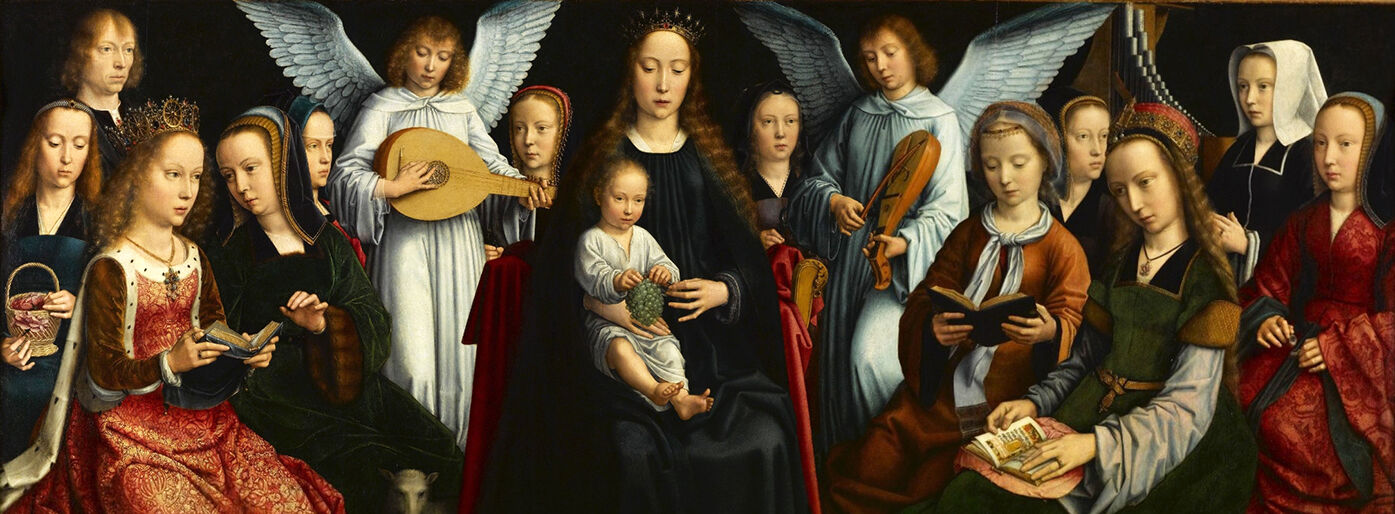
Working within a historically unparalleled amalgam of an interconnected world and regional religious- and legal reforms, Netherlandish artists active at the dawn of the ‘first globalisation’ were among the first to create consummate solutions to the question of saintly attire. The dress – and in particular the female dress – emerged as a more negotiable and contested space. At the same time as the moral restrain on saint’s clothing was loosened, a new awareness towards Otherness occurred. Whereas encounters with Black people in the flesh paved the way for a scientific stereotyping of non-Europeans in opposition to European ideals, the initial inclusion of Black people in depictions of the Adoration of Magi also reveal European artists’ changing views toward diversity and their desire to observe the world around them with increasing verisimilitude.
DRESS provides a novel research agenda for art history and material culture studies, working from the hypothesis that before the conception of non-European lands as an ‘agreeable exotic world’, all textiles enrobing bodies of the heavenly hosts harboured dynamic ontologies and were conceived by contemporary makers and viewers as negotiable and contested sites of sophistication, salvation, and sin. The project is divided into four mutually informing work packages: “Beyond Allure: Dressing the Saints in Netherlandish Altarpieces, 1480-1530” (WP1), “Dressing the Black Magus in Netherlandish Art, 1480-1530” (WP2), “The Material Magdalene in the Early Modern Parish” (WP3), and a coda, “’All that Arachne’s Art Produces Fully’: Netherlandish Poet-Painters on Textile Metaphors” (WP4).
Why DRESS now?
Given the low survival rates for clothing and textiles from pre-modern societies, it is universally acknowledged in the scholarship that visual representations of these materials in early modern art can never be taken at face value. Wearables of individuals portrayed in works of art are often reconciled with textual accounts of clothes described in inventories, sumptuary laws, and secular poetry. Consequently, dresses portrayed in the form of saints – who ranked as distinctively different from mere human beings – hardly match these textual descriptions and are often marginalised and exceptionalised as aesthetic allure. Such traditional approaches, however, neglect that representations of saints also contain information about clothing as lived reality and ‘lived religion’. Moreover, a geographical bias in the scholarship means the many contextual particularities of the globally intersected pre-modern Netherlands – each the unique result of a process of making sense of Otherness – have been overlooked. To overcome these manifold lacunae, DRESS acknowledge the unique Netherlandish context and applies a multidisciplinary approach that cross-fertilize art history, visual anthropology, material culture studies and archival studies with a careful interpretation of data from recent re-created historical artistic practices.
Project Objectives
The empirical study of dress draws on two divergent approaches: the so-called Western tradition of unveiling codes and symbols perceivable by the contemporary viewer but obscured by time, and the postcolonial approach of opposing the objectification, appropriation and stereotyping in portraits of ‘the other.’ DRESS’s main objective is to identify how Netherlandish painters manoeuvring in an increasingly global world produced new notions of gender, Otherness, and diversity within old religious ideas when dressing saints in their art. Acknowledging that human-made objects are never just material or just conceptual, but always inherently both, DRESS harbours the capacity to achieve its objectives by asking a set of research questions that for each WP carefully address an aspect of the material-religious meaning of the visualised dress and/or thing to which the art specific analyses will respond and reflect. By paying attention also to sources from the religious field, DRESS pushes forward and complements recent research on different textual witnesses to lay people’s – including artists’ and artisans’ – religious aspirations.