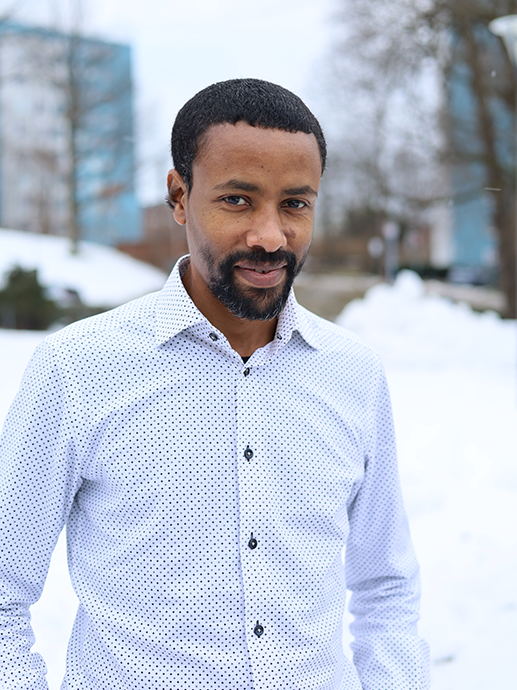
The latest addition to the Faculty of Theology comes with an interdisciplinary academic and professional background. Sileshie Semahagne Kumlachew’s journey began in Ethiopia, where he first completed a major in History and a minor in Geography at Gonder College of Teachers’ Education in 2004.
“I later earned a BA in Journalism and Communication with a minor in Law at Bahir Dar University in 2008, followed by an MA in Journalism and Communication from Addis Abeba University in 2011,” Kumlachew says.
Focused on recent controversies involving the Ethiopian Orthodox Tewahedo Church in his PhD
A strong interest in global perspectives led Kumlachew to Norway in 2018.
“I moved to Norway to pursue an MA in Global Journalism at NLA University College,” he says.
In 2025, he completed a PhD in the Sociology of Religion.
“In my PhD, I explored the socio-political context and media coverage of recent controversies involving the Ethiopian Orthodox Tewahedo Church”, Kumlachew explains.
A broad range of work experience
Kumlachew’s work experience is diverse. He has taught students at different levels in topics such as religious radicalization, evangelical and charismatic movements, and religion and media in global contexts. Alongside his academic work, he has also produced journalistic content for media outlets.
“In addition to this, I have held leadership roles in academia. At Bahir Dar University, I served as Academic Vice Dean of the Faculty of Humanities for two and a half years. Prior to that, I worked as Head of the Department of Journalism and Communication,” Kumlachew says.
Examines religion as a dynamic social force
Now Kumlachew is ready to contribute as a researcher and coordinator of the research project “The Greening Dynamics of Religion.” He looks forward to expanding his focus to include the environmental dimension of religion, and he explains that this new direction connects naturally with his previous work.
“It continues my examination of religion as a dynamic social force, one that not only shapes political and media debates, but also has the potential to influence how societies respond to pressing global challenges such as climate change and environmental degradation,” Kumlachew says.
“Significant progress has already been made in the project, and my role is to coordinate its final phase and ensure its successful completion. In addition to coordination responsibilities, I plan to work closely with other members of the research team to publish articles based on the existing data,” he adds.
What are the greening dynamics of religion? A multi-level analysis of religious environmental engagement in Switzerland
The project studies the environmental engagement of religious organisations in Switzerland. Through analysis of data from a member survey and interviews with religious umbrella organisations, the project will investigate what conditions facilitate green engagement at each level of the organisations.
Eager to be part of UiOs academic community
Even though Kumlachew is a new researcher at the University of Oslo (UiO), his connection with UiO goes back to 2011.
“I attended a summer course in Media Studies here. That experience left a lasting impression on me,” he says.
Since then, Kumlachew has hoped to one day return in a more permanent academic role.
“I am truly grateful to be here. My expectation is that the university will provide a strong intellectual platform where I can learn from experienced colleagues. Being part of this community offers an invaluable opportunity to grow, through collaboration, mentorship, and active engagement in research and teaching,” he concludes.